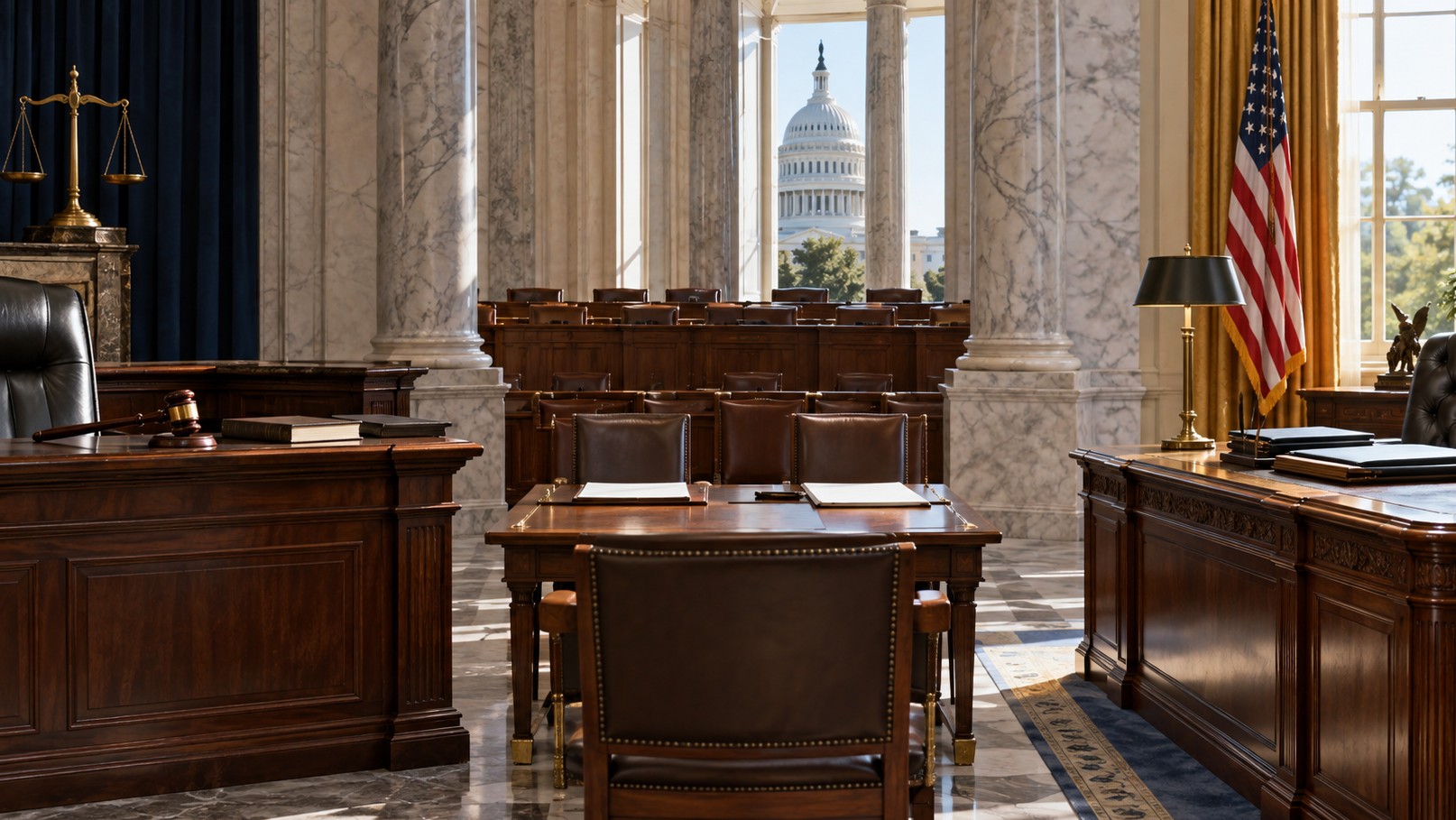
Checks and Balances Keep Government Power From Settling in One Place
Checks and balances are the constitutional tools that allow different parts of government to limit one another. They are designed to prevent ambition, party loyalty, or emergency pressure from giving one branch unchecked control. The system can slow government, but the delay is meant to protect liberty, legality, and public accountability.
A: Public decisions pass through rules, budgets, negotiations, legal review, and implementation limits.
A: No. A law creates authority, while policy includes the plans and actions used to carry it out.
A: Parties organize voters, candidates, agendas, committees, fundraising, and legislative priorities.
A: Yes, especially when it affects elections, coalitions, protests, media attention, or official legitimacy.
A: Courts interpret legal boundaries that shape what officials and agencies can do.
A: Reform has to survive law, funding, administration, opposition, and unintended consequences.
A: History, institutions, party systems, courts, budgets, and public values differ.
A: Ask who has authority, what rule changes, how it is funded, and how results are measured.
A: Local offices often handle services people experience directly, including zoning, schools, roads, and public safety.
A: Transparency, accountability, fair procedure, competent service, and public correction of mistakes.
Why Checks and Balances Exist
Checks and balances begin from the idea that power is necessary but dangerous. Government needs authority to tax, regulate, defend, punish, and serve, but that authority can be abused if no institution can resist it.
The founders of the American system divided power among legislative, executive, and judicial branches so each would have tools to defend its role.
The design assumes disagreement. It does not expect officials to be perfectly virtuous; it gives institutions reasons and methods to challenge one another.
Congress Checks the President
Congress checks the president through legislation, funding, investigations, confirmations, impeachment, war powers, and oversight hearings.
The power of the purse is especially important. The executive branch cannot spend money unless Congress appropriates it, and funding choices can shape policy.
Congress can also expose wrongdoing through hearings and subpoenas, though oversight depends on political will and respect for institutional responsibility.
The President Checks Congress
The president can veto legislation, forcing Congress to gather a supermajority if it wants to override the veto. This gives the executive a major role in lawmaking.
Presidents also influence Congress through public speeches, budget proposals, party leadership, negotiations, and agenda-setting.
The veto is a check, not a substitute for legislation. A president can block a bill, but durable policy usually requires statutory authority and funding.
Courts Check Both Political Branches
Courts can review laws and executive actions when cases arise. Judicial review allows courts to determine whether government action violates the Constitution or conflicts with statutes.
This power can protect rights and legal boundaries, but it also creates tension because judges can block decisions made by elected officials.
Judicial legitimacy depends on legal reasoning, independence, procedure, and public acceptance that courts are applying law rather than simply choosing political outcomes.
Appointments and Confirmation
The appointments process is a major check. Presidents nominate judges, cabinet officials, ambassadors, and other officers, while the Senate confirms many of those choices.
This system prevents presidents from filling key offices entirely alone. It also gives senators a way to examine qualifications, ethics, ideology, and independence.
Confirmation fights can become partisan, but the underlying purpose is serious: public offices should be staffed through accountable scrutiny.
Impeachment and Removal
Impeachment is one of the most dramatic checks. The House can impeach certain officials, and the Senate can try them and potentially remove them from office.
Impeachment is not a normal policy disagreement. It is meant for serious misconduct, abuse, or betrayal of public trust.
Because impeachment is political and constitutional at the same time, it depends on evidence, public legitimacy, and whether lawmakers are willing to place institutional duty above party protection.
Federalism as an Additional Check
Federalism divides power between national and state governments. States can challenge federal action in court, administer programs differently, and serve as sites of policy experimentation.
This division can protect local control and create alternatives, but it can also produce inequality or conflict when rights and services vary by state.
Federalism is not one of the three branches, but it is part of the larger American system of divided power.
When Checks Fail
Checks fail when institutions refuse to use them, when parties protect leaders at any cost, when courts are ignored, when oversight is blocked, or when the public stops caring about procedure.
They can also fail through overuse. If every tool becomes a partisan weapon, citizens may stop distinguishing real accountability from political theater.
The system requires judgment. Checks should be strong enough to restrain abuse and responsible enough not to make ordinary governing impossible.
Why Norms Matter Alongside Rules
Checks and balances are written into law, but they also depend on norms. Officials have to believe that hearings, subpoenas, court rulings, confirmations, and budget limits deserve respect even when they are inconvenient.
A rule can exist on paper while becoming weak in practice if leaders ignore it, delay it, or punish people who try to enforce it. Norms make formal tools usable.
This is why constitutional health cannot be measured only by whether institutions still exist. The deeper question is whether officials and citizens still accept the habits that let those institutions restrain power.
Norms are hardest to defend when they slow down one’s own side. That is also when they matter most, because a check that applies only to opponents is not really a constitutional principle.
Checks Are Not the Same as Gridlock
Checks and balances are sometimes blamed for every delay, but delay alone does not prove the system is failing. Some delays are the result of legitimate review, divided public opinion, or the need to negotiate durable law.
Gridlock becomes a deeper problem when institutions cannot perform basic duties such as funding government, confirming necessary officials, or responding to emergencies.
The civic question is whether a check is being used to improve accountability or to make ordinary governing impossible. That difference matters when judging institutional conflict.
How to Recognize a Real Check on Power
A real check on power has legal authority, a defined process, and consequences. Criticism alone is not a check unless it connects to votes, funding, courts, investigations, or elections.
Ask whether the institution using the check is defending a constitutional role or merely seeking partisan advantage. Motives can be mixed, but the evidence and procedure still matter.
Citizens should also watch whether officials accept legitimate checks when their own side is in power. That is the harder test of constitutional commitment.
Checks and balances work only when people are willing to use them and willing to be bound by them.
Why This Topic Still Matters in Public Life
In public life, Checks and Balances: How the Branches of Government Keep Each Other in Check matters most when it moves from a label into a chain of real decisions. The article’s main themes around Checks, Balances, and Branches should help a reader see who has authority, what choices are available, and why the outcome matters beyond a headline or campaign phrase.
For Checks and Balances: How the Branches of Government Keep Each Other in Check, institutional responsibility is the first anchor. The sections on federalism as an additional check, when checks fail, and why norms matter alongside rules point to the offices, rules, habits, or political pressures that turn an abstract issue into action. That keeps the topic grounded in visible structures instead of leaving it as a broad opinion about public affairs.
The public-facing side of Checks and Balances: How the Branches of Government Keep Each Other in Check is just as important. A local resident might meet the issue through a vote, public office, agency notice, court dispute, community meeting, budget choice, or service request. The topic becomes easier to judge when those encounters show what people can ask, challenge, use, support, or oppose.
The tradeoffs in Checks and Balances: How the Branches of Government Keep Each Other in Check also deserve attention. The topic can involve speed, fairness, cost, liberty, security, representation, expertise, and trust at the same time. Strong public judgment comes from naming those tradeoffs plainly and showing why reasonable people may weigh them differently.
Accountability gives Checks and Balances: How the Branches of Government Keep Each Other in Check its practical test. The article has to make clear which institution can act, which record can be checked, which promise can be tested, and which remedy exists if the system fails. That review has to stay close to the public record, because durable trust grows from traceable decisions rather than confident language alone. Without that trail, public language can sound impressive while leaving ordinary people unsure where responsibility actually sits.
That is why this topic should be read through consequences as well as definitions. The details in checks are not the same as gridlock and how to recognize a real check on power matter because they show whether the topic affects a narrow procedural question, a durable public rule, or a broader argument about how power should be organized.
People do not need to memorize every technical term in Checks and Balances: How the Branches of Government Keep Each Other in Check. It is enough to ask what changed, who benefits, who carries the burden, what safeguards exist, and whether the public can review the result. Those questions turn the subject into usable public knowledge.
Viewed that way, Checks and Balances: How the Branches of Government Keep Each Other in Check becomes less about a single definition and more about responsible public judgment. The point is to understand how decisions are made, how they are limited, and how citizens can recognize whether the system is doing the work it claims to do.
History adds another layer to Checks and Balances: How the Branches of Government Keep Each Other in Check. The meaning of the topic can change as institutions mature, public expectations shift, and later conflicts reveal weaknesses that were easier to miss at first. Looking at the subject over time helps readers separate temporary controversy from durable change.
Scale changes how Checks and Balances: How the Branches of Government Keep Each Other in Check works. The local version of the issue may reveal delays, costs, or responsibilities that national summaries tend to flatten. A national argument may look simple from a distance, while local offices, courts, schools, agencies, or community groups experience the issue in uneven ways. The closer a reader gets to implementation, the easier it becomes to see why broad promises need practical design.
Language around Checks and Balances: How the Branches of Government Keep Each Other in Check also has to be tested against action. If leaders describe the issue as reform, protection, freedom, stability, efficiency, or fairness, the next question is how that claim appears in budgets, deadlines, procedures, staff capacity, and public results.
A practical view of Checks and Balances: How the Branches of Government Keep Each Other in Check leaves room for disagreement without making the subject vague. People may value Checks, Balances, and Branches differently, but they can still argue from a clearer shared picture of what the institutions are doing and what consequences follow.
The lasting lesson from Checks and Balances: How the Branches of Government Keep Each Other in Check is that public issues are rarely solved by one speech, one vote, one ruling, or one headline. The topic becomes understandable when people trace the connections among authority, incentives, implementation, oversight, and the people affected by the final decision.
For Checks and Balances: How the Branches of Government Keep Each Other in Check, the strongest public explanation also keeps the human consequence in view. Institutions matter because they decide who waits, who pays, who receives protection, who gains access, who faces limits, and who has enough information to respond.
The subject also benefits from comparison. Looking at federalism as an additional check beside why norms matter alongside rules shows whether the issue is mainly about design, leadership, legal authority, public behavior, or the friction between several forces at once.
That broader frame makes Checks and Balances: How the Branches of Government Keep Each Other in Check more useful than a stand-alone definition. It gives the topic enough context to support judgment, enough detail to avoid oversimplifying, and enough practical grounding to keep the discussion connected to real public life.
Bottom Line on Checks and Balances
Checks and balances prevent government power from settling permanently in one branch or one leader’s hands.
They can slow action, but they protect the public by making power answerable to law, institutions, and review.