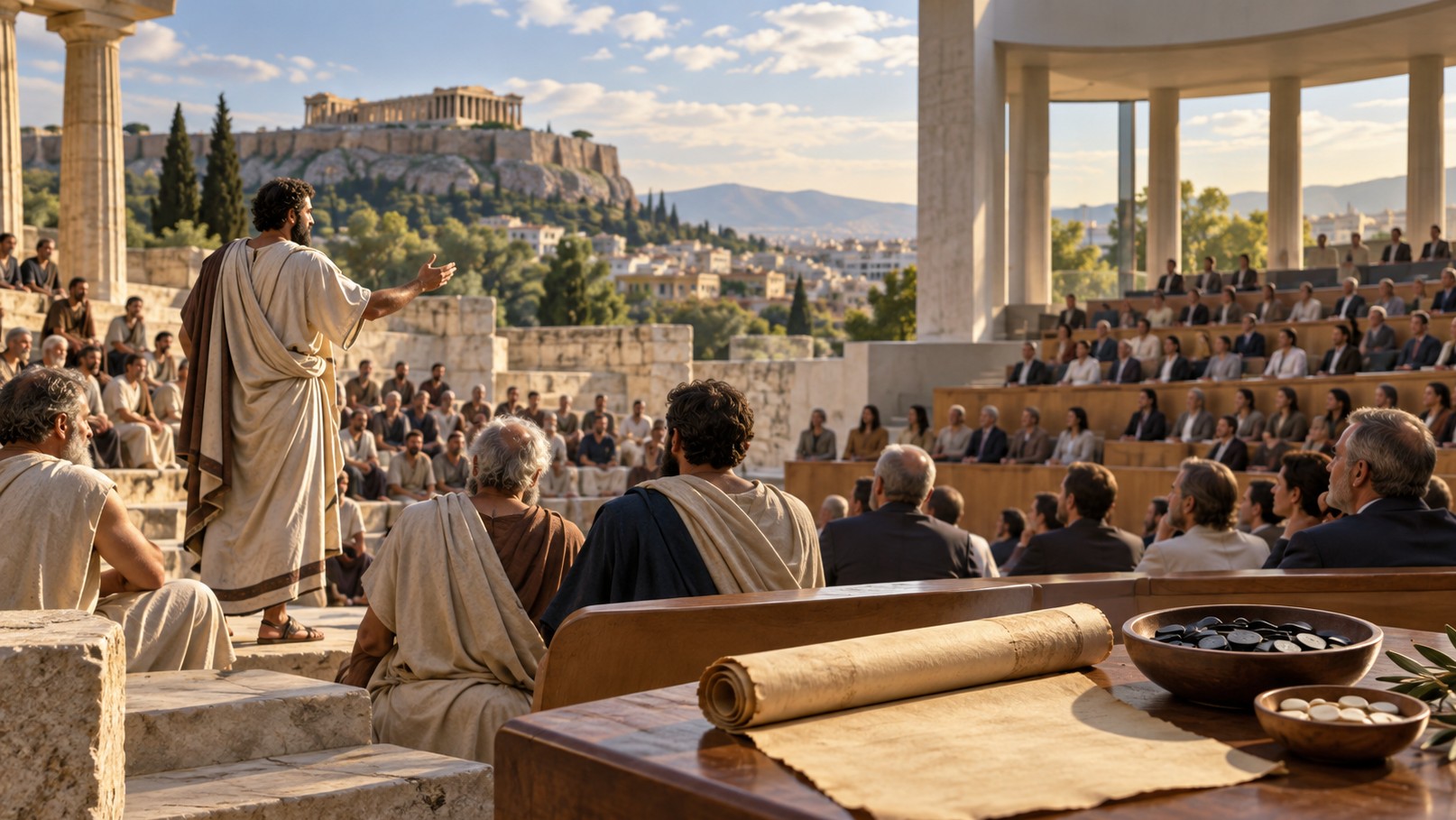
Political Ideologies Give Public Arguments a Deeper Structure
Political ideologies are systems of ideas about power, freedom, equality, order, justice, property, identity, and the role of government. They help people explain what society is, what it should become, and which public choices are legitimate. Ideologies can clarify politics, but they can also harden disagreement when people treat every issue as proof that only their side understands reality.
A: Public decisions pass through rules, budgets, negotiations, legal review, and implementation limits.
A: No. A law creates authority, while policy includes the plans and actions used to carry it out.
A: Parties organize voters, candidates, agendas, committees, fundraising, and legislative priorities.
A: Yes, especially when it affects elections, coalitions, protests, media attention, or official legitimacy.
A: Courts interpret legal boundaries that shape what officials and agencies can do.
A: Reform has to survive law, funding, administration, opposition, and unintended consequences.
A: History, institutions, party systems, courts, budgets, and public values differ.
A: Ask who has authority, what rule changes, how it is funded, and how results are measured.
A: Local offices often handle services people experience directly, including zoning, schools, roads, and public safety.
A: Transparency, accountability, fair procedure, competent service, and public correction of mistakes.
What Political Ideologies Do
An ideology gives politics a pattern. Instead of treating taxes, courts, schools, policing, welfare, immigration, and foreign policy as isolated questions, it connects them to a larger view of human nature and public authority.
That structure is useful because public life is too complicated to approach one detail at a time. Ideologies provide shortcuts, priorities, and moral language that help people make decisions.
The danger is that ideology can become a filter that blocks evidence. When every fact is forced into a preexisting story, ideology stops helping people think and starts protecting them from thinking.
Liberalism and Individual Rights
Liberalism developed around ideas of individual rights, constitutional limits, consent of the governed, equal citizenship, and protection from arbitrary power. In different countries, the word liberal can mean different things, but the tradition is deeply tied to rights and lawful government.
Classical liberalism emphasized limited government, property rights, markets, free expression, and religious toleration. Modern social liberalism often adds stronger support for public programs, civil rights enforcement, and government action to expand opportunity.
The tension inside liberalism is how to balance liberty and equality. A society can protect formal freedom while leaving people without practical access to education, health, security, or political voice.
Conservatism and Social Continuity
Conservatism is often associated with tradition, order, social continuity, local institutions, religion, family, national identity, and caution toward rapid change. It argues that inherited practices may contain wisdom that abstract plans overlook.
Conservative politics can defend limited government and market freedom, but it can also support strong state authority in areas such as law, borders, national defense, or public morality. The exact mix depends on history and country.
The strength of conservatism is its attention to unintended consequences. Its weakness appears when respect for tradition becomes defense of injustice or refusal to adapt when institutions clearly fail.
Socialism and Economic Equality
Socialism focuses on economic power, inequality, labor, public ownership, social welfare, and democratic control over resources. It begins from the belief that markets can concentrate power and leave many people without real freedom.
Socialist traditions vary widely. Some pursue democratic reform through elections, unions, and welfare policy. Others have pursued revolutionary one-party rule, which has often produced repression and centralized control.
The central debate is how to combine equality, productivity, democracy, and personal freedom. Socialism’s appeal comes from real economic grievances, while its risks appear when state power becomes insulated from accountability.
Nationalism and Political Belonging
Nationalism argues that a people with shared identity, history, language, culture, or political destiny should have self-government. It has inspired independence movements, anti-colonial struggles, and democratic solidarity.
Nationalism can also become exclusionary when it defines the nation narrowly and treats minorities, immigrants, critics, or outsiders as threats. The same language of belonging can protect self-rule or justify domination.
Modern politics often turns on this tension. Citizens want community and shared purpose, but democracies must decide whether national identity is open enough to include the full public.
Authoritarianism and Control
Authoritarian ideologies prioritize order, hierarchy, obedience, national unity, party control, or leader authority over open competition and civil liberty. They often claim that democracy is too chaotic to handle crisis or national renewal.
Authoritarian systems can move quickly, but speed is not the same as wisdom. When opposition, courts, press, and civic groups are weakened, leaders may receive less honest information and citizens have fewer ways to correct abuse.
The appeal of authoritarianism often rises when people feel unsafe, humiliated, or economically abandoned. That appeal makes democratic performance important; weak democracies can create openings for anti-democratic promises.
Why Ideologies Change Over Time
Ideologies are not frozen. Parties and movements reinterpret them as economies change, wars occur, social movements rise, technology develops, and new generations ask different questions.
A conservative party in one country may support policies that would look liberal elsewhere. A liberal movement may emphasize markets in one era and social protection in another. Labels need context.
The best way to understand ideology is to ask what values it emphasizes, what institutions it trusts, what problems it fears most, and what tradeoffs it is willing to accept.
Why Ideology Still Matters in Everyday Policy
Ideology shows up in practical decisions even when officials avoid ideological language. A school budget, housing rule, tax plan, policing policy, or health program carries assumptions about responsibility, fairness, and public authority.
Two people may agree that a problem exists while disagreeing completely about what caused it and who should solve it. Those disagreements often come from ideological starting points rather than from ignorance.
Recognizing ideology can make debate more honest. Instead of pretending every dispute is technical, citizens can name the values being weighed and ask whether the policy actually serves them.
How to Use Ideology Without Becoming Trapped by It
Ideology is useful when it helps citizens ask consistent questions. It becomes dangerous when it makes every answer automatic. A healthy political mind can hold values firmly while still testing whether a policy works.
Citizens can compare ideologies by asking what each one protects and what each one risks. Liberalism protects rights but can understate social fragmentation. Conservatism protects continuity but can defend unfair arrangements. Socialism challenges inequality but can overtrust state control. Nationalism builds belonging but can exclude.
It also helps to separate ideology from party branding. Parties borrow ideological words, but their actual behavior may reflect donors, electoral geography, leadership ambition, or short-term strategy.
A mature public debate does not require people to abandon ideology. It requires them to know what their ideology highlights, what it ignores, and when evidence should force revision.
Why This Topic Still Matters in Public Life
Political Ideologies Explained: The Ideas That Shaped World History becomes clearer when the subject is treated as a working public system rather than a slogan. The article’s main themes around Political, Ideologies, and Ideas should help a reader see who has authority, what choices are available, and why the outcome matters beyond a headline or campaign phrase.
For Political Ideologies Explained: The Ideas That Shaped World History, institutional responsibility is the first anchor. The sections on nationalism and political belonging, authoritarianism and control, and why ideologies change over time point to the offices, rules, habits, or political pressures that turn an abstract issue into action. That keeps the topic grounded in visible structures instead of leaving it as a broad opinion about public affairs.
The public-facing side of Political Ideologies Explained: The Ideas That Shaped World History is just as important. The public may encounter the issue through school rules, taxes, permits, public safety, campaign messages, legal rights, or international events. The topic becomes easier to judge when those encounters show what people can ask, challenge, use, support, or oppose.
The tradeoffs in Political Ideologies Explained: The Ideas That Shaped World History also deserve attention. The topic can involve speed, fairness, cost, liberty, security, representation, expertise, and trust at the same time. Strong public judgment comes from naming those tradeoffs plainly and showing why reasonable people may weigh them differently.
Accountability gives Political Ideologies Explained: The Ideas That Shaped World History its practical test. The article has to make clear which institution can act, which record can be checked, which promise can be tested, and which remedy exists if the system fails. That review should make responsibility visible enough that people can tell whether a promise became action or stopped at rhetoric. Without that trail, public language can sound impressive while leaving ordinary people unsure where responsibility actually sits.
That is why this topic should be read through consequences as well as definitions. The details in why ideology still matters in everyday policy and how to use ideology without becoming trapped by it matter because they show whether the topic affects a narrow procedural question, a durable public rule, or a broader argument about how power should be organized.
People do not need to memorize every technical term in Political Ideologies Explained: The Ideas That Shaped World History. It is enough to ask what changed, who benefits, who carries the burden, what safeguards exist, and whether the public can review the result. Those questions turn the subject into usable public knowledge.
Viewed that way, Political Ideologies Explained: The Ideas That Shaped World History becomes less about a single definition and more about responsible public judgment. The point is to understand how decisions are made, how they are limited, and how citizens can recognize whether the system is doing the work it claims to do.
History adds another layer to Political Ideologies Explained: The Ideas That Shaped World History. The meaning of the topic can change as institutions mature, public expectations shift, and later conflicts reveal weaknesses that were easier to miss at first. Looking at the subject over time helps readers separate temporary controversy from durable change.
Scale changes how Political Ideologies Explained: The Ideas That Shaped World History works. A broad debate may hide the local steps, staff capacity, records, and appeal paths that determine how the issue works in practice. A national argument may look simple from a distance, while local offices, courts, schools, agencies, or community groups experience the issue in uneven ways. The closer a reader gets to implementation, the easier it becomes to see why broad promises need practical design.
Language around Political Ideologies Explained: The Ideas That Shaped World History also has to be tested against action. If leaders describe the issue as reform, protection, freedom, stability, efficiency, or fairness, the next question is how that claim appears in budgets, deadlines, procedures, staff capacity, and public results.
A practical view of Political Ideologies Explained: The Ideas That Shaped World History leaves room for disagreement without making the subject vague. People may value Political, Ideologies, and Ideas differently, but they can still argue from a clearer shared picture of what the institutions are doing and what consequences follow.
The lasting lesson from Political Ideologies Explained: The Ideas That Shaped World History is that public issues are rarely solved by one speech, one vote, one ruling, or one headline. The topic becomes understandable when people trace the connections among authority, incentives, implementation, oversight, and the people affected by the final decision.
For Political Ideologies Explained: The Ideas That Shaped World History, the strongest public explanation also keeps the human consequence in view. Institutions matter because they decide who waits, who pays, who receives protection, who gains access, who faces limits, and who has enough information to respond.
The subject also benefits from comparison. Looking at nationalism and political belonging beside why ideologies change over time shows whether the issue is mainly about design, leadership, legal authority, public behavior, or the friction between several forces at once.
That broader frame makes Political Ideologies Explained: The Ideas That Shaped World History more useful than a stand-alone definition. It gives the topic enough context to support judgment, enough detail to avoid oversimplifying, and enough practical grounding to keep the discussion connected to real public life.
Bottom Line on Political Ideologies
Political ideologies shape how people understand power, rights, equality, order, nationhood, markets, and government. They organize public argument and give voters a way to compare visions of society.
The best civic use of ideology is disciplined but humble: know your values, test your assumptions, and remember that no ideology removes the need for evidence and accountability.