Democracy’s Origins Show How Popular Rule Grew Through Citizenship, Debate, Rights, and Institutional Limits
Democracy is the idea that political authority should answer to the people, but that idea has taken many forms across history. Ancient assemblies, republics, parliaments, constitutions, voting rights movements, parties, courts, and civil society all shaped what democracy became. Its origins are not a simple story of steady progress. Democracy grew through conflict over who counted as a citizen, how power should be limited, and how ordinary people could influence decisions that governed their lives.
A: Public decisions pass through rules, budgets, negotiations, legal review, and implementation limits.
A: No. A law creates authority, while policy includes the plans and actions used to carry it out.
A: Parties organize voters, candidates, agendas, committees, fundraising, and legislative priorities.
A: Yes, especially when it affects elections, coalitions, protests, media attention, or official legitimacy.
A: Courts interpret legal boundaries that shape what officials and agencies can do.
A: Reform has to survive law, funding, administration, opposition, and unintended consequences.
A: History, institutions, party systems, courts, budgets, and public values differ.
A: Ask who has authority, what rule changes, how it is funded, and how results are measured.
A: Local offices often handle services people experience directly, including zoning, schools, roads, and public safety.
A: Transparency, accountability, fair procedure, competent service, and public correction of mistakes.
Ancient Roots
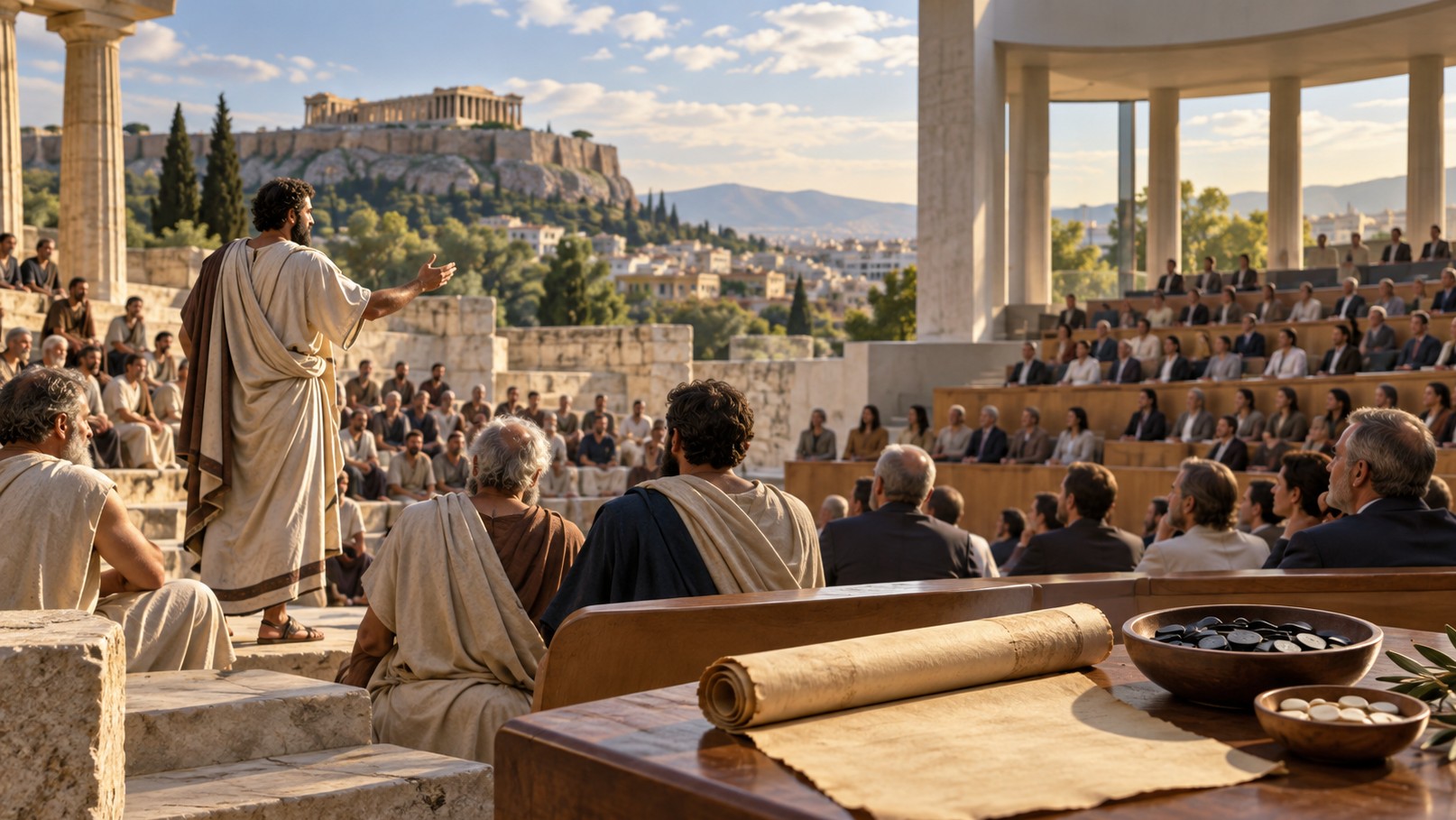
Ancient Athens is often associated with early democracy because male citizens could participate directly in assemblies, juries, and public decisions.
Athenian democracy was limited. Women, enslaved people, foreigners, and many others were excluded, which shows that democratic language can coexist with sharp inequality.
The lasting contribution was the idea that citizens could deliberate about public affairs rather than simply obey kings or aristocrats.
Republican Traditions
The Roman Republic offered another model built around mixed institutions, elected offices, law, civic duty, and suspicion of concentrated power.
Rome was not a modern democracy, but its republican language influenced later thinkers who cared about representation, public virtue, and checks on tyranny.
The republic also showed that institutions can decay when wealth, military power, and personal ambition overwhelm civic restraint.
Medieval Charters and Limits
Medieval politics included monarchs, nobles, churches, towns, guilds, and assemblies that sometimes limited royal authority.
Documents such as Magna Carta did not create democracy as we know it, but they helped develop the principle that rulers could be bound by law.
The idea of limited government became an important foundation for later constitutional democracy.
Parliament and Representation
Representative institutions grew as rulers needed taxes, consent, and cooperation from organized groups.
Parliaments and estates assemblies gave some groups a voice, though participation was usually restricted by class, property, gender, or status.
Representation changed democracy by making popular influence possible in large territories where direct assembly could not work.
Enlightenment Ideas
Enlightenment thinkers argued about natural rights, consent, social contracts, separation of powers, liberty, equality, and religious toleration.
These ideas influenced revolutions and constitutions, but they were often applied unevenly. Many societies proclaimed liberty while excluding women, enslaved people, Indigenous peoples, and the poor.
The tension between universal language and restricted practice became one engine of later democratic reform.
Revolutions and Constitutions
The American, French, Haitian, and other revolutions challenged inherited authority and raised questions about rights, citizenship, sovereignty, and representation.
Revolutionary politics showed that people could remake political systems, but it also showed that democratic language could produce violence, exclusion, or authoritarian reaction.
Constitutions became tools for organizing popular power while trying to limit abuses by both rulers and majorities.
Voting Rights Expansion
Modern democracy expanded as property restrictions fell, slavery was abolished, women won suffrage, racial barriers were challenged, and younger citizens gained voting rights.
Each expansion was contested because voting changes the distribution of power.
The history of democracy is therefore also the history of people demanding inclusion from systems that claimed to represent the public while excluding them.
Parties, Press, and Civil Society
Democracy needs more than elections. Parties organize choices, the press informs the public, and civic groups help people advocate between elections.
Civil society can train citizens in debate, organizing, leadership, and accountability.
When parties become corrupt, media becomes captured, or civic groups are suppressed, elections alone may not protect democracy.
Democratic Ideologies
Popular rule has been defended through liberal, republican, socialist, nationalist, and participatory traditions.
These traditions disagree over what democracy requires: individual rights, civic virtue, economic equality, national self-rule, local participation, or institutional pluralism.
Modern democracies often combine several traditions, which is why democratic debate can be intense even among people who all claim to support democracy.
Direct and Representative Democracy
Direct democracy lets citizens vote directly on laws or public questions. It can make participation immediate, but it can also oversimplify technical issues or expose minority rights to sudden majorities.
Representative democracy asks citizens to choose officials who deliberate, negotiate, and make decisions on their behalf.
Most modern democracies mix the two through elections, referendums, initiatives, public comment, local meetings, and representative institutions.
Rights as Democratic Guardrails
Democracy is not only majority rule. Rights protect speech, religion, due process, equal protection, and political participation so that majorities cannot erase the conditions of future democracy.
Those guardrails matter because a temporary majority can be tempted to silence critics, manipulate elections, or exclude unpopular groups.
A durable democracy therefore needs both popular power and limits on how that power can be used.
Democratic Backsliding
Democratic backsliding happens when elected leaders weaken elections, courts, media, opposition parties, civil service, or civic groups while claiming to speak for the people.
It is dangerous because it can use democratic language to reduce democratic accountability.
The history of democracy’s origins helps explain why institutions matter. Popular rule needs channels for change, but it also needs limits that stop winners from closing the system behind them.
That lesson connects ancient exclusion, constitutional limits, and modern voting rights into one continuing civic problem.
Democracy survives through habits as well as rules.
How to Understand Democracy’s Origins Today
A useful view of democracy asks who participates, how decisions are made, what rights limit majorities, and how power can be corrected.
Avoid treating democracy as only voting. Elections matter, but so do courts, free expression, fair administration, civic organization, and peaceful transfer of power.
Watch the gap between democratic ideals and democratic practice. Much of democratic history is the effort to close that gap.
The origins of democracy are best understood as a long argument over whether public power belongs to rulers, elites, or the people themselves.
Why This Topic Still Matters in Public Life
The clearest way to understand The Origins of Democracy and the Ideologies Behind Popular Rule is to ask how the idea changes authority, responsibility, and public expectations. The article’s main themes around Origins, Democracy, and Ideologies should help a reader see who has authority, what choices are available, and why the outcome matters beyond a headline or campaign phrase.
For The Origins of Democracy and the Ideologies Behind Popular Rule, institutional responsibility is the first anchor. The sections on democratic ideologies, direct and representative democracy, and rights as democratic guardrails point to the offices, rules, habits, or political pressures that turn an abstract issue into action. That keeps the topic grounded in visible structures instead of leaving it as a broad opinion about public affairs.
The public-facing side of The Origins of Democracy and the Ideologies Behind Popular Rule is just as important. For ordinary people, the issue may show up through access, cost, risk, representation, legal duties, public trust, or the ability to challenge a decision. The topic becomes easier to judge when those encounters show what people can ask, challenge, use, support, or oppose.
The tradeoffs in The Origins of Democracy and the Ideologies Behind Popular Rule also deserve attention. The topic can involve speed, fairness, cost, liberty, security, representation, expertise, and trust at the same time. Strong public judgment comes from naming those tradeoffs plainly and showing why reasonable people may weigh them differently.
Accountability gives The Origins of Democracy and the Ideologies Behind Popular Rule its practical test. The article has to make clear which institution can act, which record can be checked, which promise can be tested, and which remedy exists if the system fails. That review is stronger when it follows the trail from public claim to legal authority, implementation, oversight, and correction. Without that trail, public language can sound impressive while leaving ordinary people unsure where responsibility actually sits.
That is why this topic should be read through consequences as well as definitions. The details in democratic backsliding and how to understand democracy’s origins today matter because they show whether the topic affects a narrow procedural question, a durable public rule, or a broader argument about how power should be organized.
People do not need to memorize every technical term in The Origins of Democracy and the Ideologies Behind Popular Rule. It is enough to ask what changed, who benefits, who carries the burden, what safeguards exist, and whether the public can review the result. Those questions turn the subject into usable public knowledge.
Viewed that way, The Origins of Democracy and the Ideologies Behind Popular Rule becomes less about a single definition and more about responsible public judgment. The point is to understand how decisions are made, how they are limited, and how citizens can recognize whether the system is doing the work it claims to do.
History adds another layer to The Origins of Democracy and the Ideologies Behind Popular Rule. The meaning of the topic can change as institutions mature, public expectations shift, and later conflicts reveal weaknesses that were easier to miss at first. Looking at the subject over time helps readers separate temporary controversy from durable change.
Scale changes how The Origins of Democracy and the Ideologies Behind Popular Rule works. The closer the subject gets to implementation, the more important it becomes to ask who has the staff, money, and authority to carry it out. A national argument may look simple from a distance, while local offices, courts, schools, agencies, or community groups experience the issue in uneven ways. The closer a reader gets to implementation, the easier it becomes to see why broad promises need practical design.
Language around The Origins of Democracy and the Ideologies Behind Popular Rule also has to be tested against action. If leaders describe the issue as reform, protection, freedom, stability, efficiency, or fairness, the next question is how that claim appears in budgets, deadlines, procedures, staff capacity, and public results.
A practical view of The Origins of Democracy and the Ideologies Behind Popular Rule leaves room for disagreement without making the subject vague. People may value Origins, Democracy, and Ideologies differently, but they can still argue from a clearer shared picture of what the institutions are doing and what consequences follow.
The lasting lesson from The Origins of Democracy and the Ideologies Behind Popular Rule is that public issues are rarely solved by one speech, one vote, one ruling, or one headline. The topic becomes understandable when people trace the connections among authority, incentives, implementation, oversight, and the people affected by the final decision.
For The Origins of Democracy and the Ideologies Behind Popular Rule, the strongest public explanation also keeps the human consequence in view. Institutions matter because they decide who waits, who pays, who receives protection, who gains access, who faces limits, and who has enough information to respond.
The subject also benefits from comparison. Looking at democratic ideologies beside rights as democratic guardrails shows whether the issue is mainly about design, leadership, legal authority, public behavior, or the friction between several forces at once.
That broader frame makes The Origins of Democracy and the Ideologies Behind Popular Rule more useful than a stand-alone definition. It gives the topic enough context to support judgment, enough detail to avoid oversimplifying, and enough practical grounding to keep the discussion connected to real public life.
Bottom Line on Democracy’s Origins
Democracy grew through ancient citizenship, republican limits, representative institutions, rights language, revolutions, and voting rights struggles.
Its history shows that popular rule is not self-protecting. It has to be built, expanded, limited, and defended by institutions and citizens.